Quick Guide
Okay, let's talk about something that's been on my mind a lot lately. You've probably seen the photos – vast stretches of underwater landscape that look like a ghost town, corals that have gone from vibrant purples and oranges to a uniform, deathly white. That's coral bleaching. And if you're a diver, or thinking about becoming one, you're going to encounter it. It changes everything about a dive, from what you see to how you feel when you surface.
I remember my first major encounter with a bleached reef. It was in a place that was legendary in dive magazines just a decade prior. The guidebook photos showed explosions of color. What I saw was... quiet. Subdued. It wasn't devoid of life, but the main event, the corals themselves, looked sick. Pale. It felt less like exploring a rainforest and more like walking through a hospital ward. That trip stuck with me. It shifted my whole perspective from just "seeing cool stuff" to wanting to understand what was happening.
So, what's the deal with coral bleaching and diving? Is it pointless to dive on a bleached reef? Should we avoid these areas altogether? What can we, as individuals with fins and a love for the ocean, actually do? This guide isn't just science-lite. We're going to dig into the biology, the hard truth about what you'll witness, and – crucially – the practical, tangible actions that make a difference. Because understanding is the first step to helping.
The Science Bit: What Is Coral Bleaching, Really?
Let's clear up a huge misconception right away. A bleached coral is not a dead coral. Not immediately, anyway. It's a stressed coral that's in critical condition. Think of it as a coral in the ICU.
Corals are these amazing little animals (polyps) that live in a symbiotic partnership with even tinier algae called zooxanthellae. The algae live inside the coral's tissue. This is a perfect deal: the algae get a safe home and some waste products (nitrogen, phosphorus), and in return, through photosynthesis, they provide the coral with up to 90% of its energy – basically, its food. They're also what give corals their spectacular colors.
Here's where the "bleaching" comes in. When the coral gets severely stressed – and the number one stressor is increased water temperature – this happy partnership breaks down. The heat damages the algae's photosynthetic machinery, causing them to produce toxins. To save itself, the coral expels its algal partners. It's a survival move, like jettisoning cargo from a sinking ship.
The Critical Point: Without its algae, the coral is starving. It can still feed at night using its tentacles to catch plankton, but it's like trying to live on snacks after losing your main job. If the stress is removed and water temperatures return to normal quickly enough – within a few weeks – the algae can move back in and the coral can recover. If the stress persists... the coral will eventually die from disease or outright starvation.
The main driver is climate change, full stop. Warmer oceans mean more frequent and severe marine heatwaves. But it's not the only stressor. Pollution from land (fertilizer runoff, sewage), over-sedimentation from coastal development, and even physical damage from careless anchors or divers can all add up, making corals more vulnerable to temperature spikes.
What Does a Bleached Reef Look Like to a Diver?
This is the practical diving part. If you're planning a trip to a region known for recent bleaching events, here's what to expect. It's not all doom and gloom, but it is different.
First, the obvious: the color is gone. Vibrant reefs become monochromatic. You'll see a lot of white, bone-colored, or pastel skeletons. Sometimes corals turn neon blue or fluorescent pink just before or during bleaching – a last-ditch stress response – but that quickly fades to white.
The second thing you'll notice is the silence. I don't mean actual silence, but a visual quietness. Healthy reefs are bustling, chaotic cities. Bleached reefs feel subdued. The fish are often still there – parrotfish, angelfish, wrasses – but the backdrop, the architecture of their city, is visibly sick. It affects the vibe completely.
You might also see more algae. As corals die and their skeletons break down, algae (the seaweed kind, not the symbiotic kind) can take over, creating a green, fuzzy carpet over the reef structure. This smothers any baby corals trying to settle and grow.
But here's a question I get a lot: Is it still worth diving on a bleached reef?
My take? Yes, but with adjusted expectations. Diving on a bleached reef is arguably more important than ever. It's a firsthand education. You become a witness. It transforms the abstract concept of "climate change impact" into a visceral, unforgettable experience. You'll also likely see resilient corals that have survived, which is hopeful. And the fish life, turtles, rays, and other macro critters are often still present and worth seeing.
The Diver's Role: From Passive Observer to Active Protector
Buoyancy is Non-Negotiable
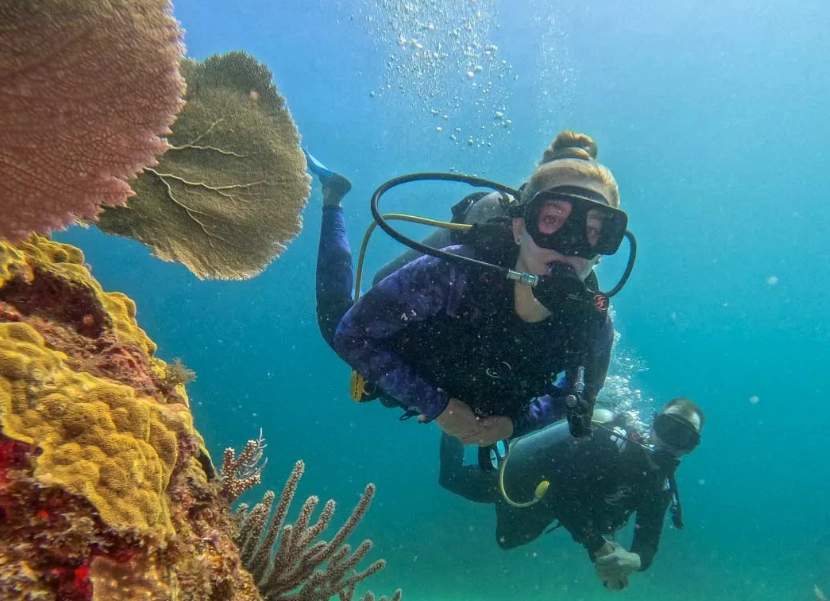
A stressed, bleached coral is incredibly fragile. A single fin kick that dislodges sediment can smother it. A clumsy handhold can break its brittle skeleton. Your buoyancy control needs to be impeccable. If you're still knocking into things, practice in a pool or over a sandy patch before hovering over the reef. This isn't just good practice; it's an ethical requirement for coral bleaching and diving in this era.
What to Touch (Hint: Nothing)
The rule is simple: don't touch anything. No coral, ever. No resting on the bottom. No "steadying" yourself on the reef. Even touching corals with "just" your fingers can remove their protective mucus layer, opening the door for infection. Gloves, in my opinion, should be left at home for tropical reef diving. They give a false sense of security and make you more likely to grab something.
Sunscreen: The Chemical Minefield
This is a big one. Many common sunscreen chemicals are proven to be toxic to corals, even in minute concentrations. They can worsen bleaching stress and prevent recovery.
| Sunscreen Ingredient | Effect on Coral | Diver's Alternative |
|---|---|---|
| Oxybenzone & Octinoxate | Causes coral bleaching, damages coral DNA, disrupts reproduction. | Avoid completely. Banned in many reef areas (Hawaii, Key West, Palau). |
| Octocrylene | Can be toxic and may accumulate in coral tissue. | Use with caution; better alternatives exist. |
| Homosalate | Disrupts coral hormones. | Seek "reef-safe" labels, but verify ingredients. |
| Mineral (Zinc Oxide, Titanium Dioxide) | Generally considered safe IF "non-nano." | Best choice. Look for "non-nano" mineral sunscreens. |
Better yet? Use physical barriers.
Put on a rash guard or a full wetsuit. A long-sleeved 3mm suit protects you from the sun and jellyfish, and means you need far less sunscreen, if any, on your body. Save the mineral sunscreen for your face, ears, and the back of your neck.
Beyond the Dive: Actions That Actually Help
Okay, so you've mastered your buoyancy and bought the right sunscreen. What else? The real impact happens outside the water.
Choose Operators Who Care
Your money is a vote. Research dive operators before you book. Look for those that:
- Explicitly mention conservation in their mission.
- Run briefings that emphasize no-touch, perfect buoyancy.
- Use mooring buoys instead of dropping anchors on the reef.
- Participate in local reef monitoring or restoration projects (like coral nurseries).
- Limit group sizes to reduce impact.
Ask them questions! A good operator will be proud to talk about their practices.
Citizen Science: Be a Data Point
You can contribute to real science. Apps and projects allow divers to report bleaching sightings, which helps scientists track events in real-time. Check out initiatives like Reef Check or the NOAA Coral Reef Watch for citizen science opportunities. Submitting a photo and location of a bleached coral you saw helps build a global picture.
The Big Picture Stuff
This is the hardest but most important part. Reducing your carbon footprint is the single biggest thing you can do for corals long-term. It's not as immediate as good buoyancy, but it tackles the root cause. Advocate for climate policies. Support renewable energy. Think about your travel footprint (can you combine trips, stay longer?). It all connects.
Also, support organizations doing the hard work on the ground and in policy. Groups like the Coral Reef Alliance or the International Coral Reef Initiative work on local solutions and global advocacy. Donating to them or volunteering your skills can have a far-reaching impact.
Facing the Hard Questions (FAQ)
A Changed Perspective
Diving after you've learned about coral bleaching is different. It can't be unseen. For a while, it stole some of the pure joy for me. It felt like watching something beautiful die slowly.
But that perspective changed. It deepened. Now, a dive isn't just a vacation activity. It's a check-up. It's a connection. Seeing a resilient, colorful coral head surrounded by bleached neighbors feels like a victory. Spotting a tiny juvenile fish hiding in the nooks of a recovering reef frame feels hopeful.
The relationship between coral bleaching and diving is now inextricable. We are diving in the Anthropocene, the age where human impact is the dominant force. Ignoring it is not an option for a responsible diver.
So go. See it for yourself. Let it move you. Let it frustrate you. Then let that feeling propel you to act – with your fins, your wallet, and your voice. The reefs need witnesses, and they need advocates. They need divers who understand that we're not just visitors to this underwater world; we're now, like it or not, its caretakers.
The adventure hasn't ended. It's just become more important.


Comments