Quick Guide
- Why Your Body Hates a Quick Trip Uphill
- Decoding the Official DAN Altitude After Diving Rules
- What Does “Altitude” Actually Mean? It’s Lower Than You Think.
- Spotting Trouble: Symptoms You Must Not Ignore
- Your Action Plan: Before, During, and After the Dive
- Straight Answers to the Questions You’re Actually Asking
- Wrapping It Up: Better Safe Than Sorry
Let’s be real for a second. You’re rinsing your gear, still buzzing from that incredible wall dive. The colors, the silence, the sheer scale of it all. Then it hits you. Your flight home is tomorrow morning. Or maybe you’ve booked a few nights in that gorgeous lodge up in the hills. A little voice in your head whispers: “Is this okay?” That, my friend, is the moment you need to think about DAN altitude after diving protocols.
It’s one of those things that doesn’t get talked about enough on the boat ride back. We’re all experts on buoyancy and air consumption down there, but the rules for what happens after we get out of the water? That’s where the confusion starts. I’ve seen too many divers shrug it off, thinking a little altitude won’t hurt. Trust me, it’s not worth the gamble.
Here’s the thing they don’t always tell you in your Open Water course: Going to altitude after diving isn’t just about flying. Driving over a mountain pass, taking a cable car, or even sleeping at a high-elevation resort can trigger decompression sickness (DCS). Your body is still off-gassing nitrogen, and reducing the atmospheric pressure around you too soon is like shaking a soda can.
Why Your Body Hates a Quick Trip Uphill
Okay, let’s ditch the complex textbook jargon. When you scuba dive, you breathe compressed air. The main player here is nitrogen. Under pressure, this nitrogen dissolves into your tissues—your blood, muscles, joints, you name it. It’s harmless while it’s dissolved.
The problem starts during your ascent. As the water pressure decreases, that dissolved nitrogen needs to come out of solution, slowly and steadily, through your lungs. This is off-gassing. It takes time. Think of your tissues like sponges at different depths; some release nitrogen quickly, others hold onto it for hours.
Now, imagine you finish this process at sea level. The pressure is “1 atmosphere.” You drive up to 2,000 meters (about 6,500 feet). The pressure up there is lower. Suddenly, the relative pressure difference between the nitrogen still in your tissues and the thinner air outside increases. This can cause the nitrogen to form bubbles where it shouldn’t. Those bubbles are what cause decompression sickness, or “the bends.” It’s not a myth; it’s simple physics.
The guidelines from the Divers Alert Network (DAN) on altitude after diving exist for one reason: to give your body enough time to shed that extra nitrogen before you subject it to even lower pressure. Ignoring them is like playing Russian roulette with your nervous system and joints.
Decoding the Official DAN Altitude After Diving Rules
DAN is the go-to authority for dive medicine, and their recommendations are what most dive computers and professionals follow. But the rules aren’t one-size-fits-all. They depend entirely on your dive profile. Let’s break it down in plain English.
The Standard Surface Interval (The One Everyone Should Know)
For a single no-decompression dive, or multiple dives in a single day where you stayed within no-decompression limits:
Wait at least 12 hours before ascending to an altitude above 300 meters (1,000 feet). This is the bare minimum for a conservative, safety-first approach.
Honestly, I think 12 hours feels a bit tight if you did a couple of deep dives. My personal rule, and what many seasoned dive guides I’ve dived with recommend, is to push it to 18-24 hours if your schedule allows. It’s just a smarter buffer.
When You’ve Pushed the Limits
If your dives were more complex—say, you incurred some decompression obligation (your computer beeped at you), or you did multiple days of repetitive diving—the wait time gets longer.
Wait at least 24 hours before going to altitude. No negotiation here. Your tissues are saturated, and they need a full day at sea level to properly unload.
I remember a trip to the Socorro Islands years ago. We were doing three intense dives a day for a week. The liveaboard crew was militant about the 24-hour rule before our charter flight back to the mainland. Nobody argued. When the pros are that strict, you listen.
The “Fly or Drive?” Question
This is a common mix-up. Commercial aircraft cabins are pressurized, but not to sea level pressure. Typically, they’re pressurized to an altitude of 1,800-2,400 meters (6,000-8,000 feet). So, flying after diving is an altitude exposure. The DAN altitude after diving guidelines apply directly to flying.
For flying, the most widely adopted recommendation is:
- For single no-decompression dives: A minimum pre-flight surface interval of 12 hours.
- For multiple days of diving or decompression dives: A minimum pre-flight surface interval of 18-24 hours. Many dive operators, including PADI and SSI, standardize on 18 hours as their recommended minimum for repetitive diving, which I find is a good practical standard.
Here’s a quick table to visualize the different recommendations for various scenarios. It’s not perfect, but it helps you plan.
| Your Dive Profile | Minimum Wait Before Altitude/Flight (DAN Conservative) | Recommended Wait (Practical/Extra Safe) |
|---|---|---|
| Single, simple no-deco dive | 12 hours | 18 hours |
| Multiple dives in one day | 12 hours | 18-24 hours |
| Multiple days of repetitive diving | 18 hours | 24 hours |
| Any dive with decompression stop | 24 hours | 24+ hours |
See the pattern? When in doubt, wait it out. Adding a few extra hours is cheap insurance.
What Does “Altitude” Actually Mean? It’s Lower Than You Think.
This is a huge point of confusion. We’re not just talking about summiting Everest. The DAN altitude after diving threshold starts at a mere 300 meters (or 1,000 feet) above your dive site.
Let that sink in. 1,000 feet. That’s lower than many cities and towns in mountainous regions. Your drive from a coastal dive site to an inland airport could easily cross this threshold. Sleeping in a hotel on a hill might do it.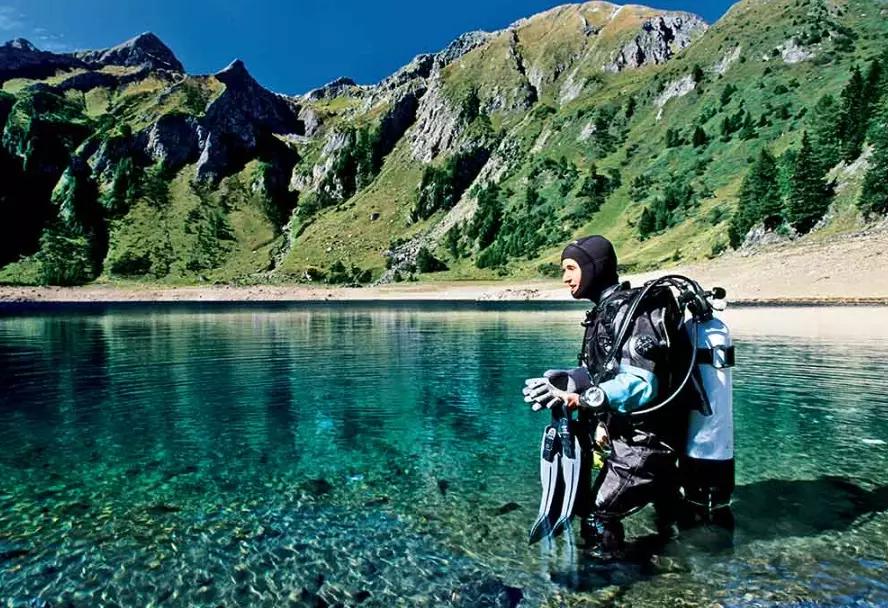
Pro Tip: Always check the elevation of your post-dive destination. Use Google Maps or a topo app. If it’s more than 300m/1000ft above your dive site, the clock starts ticking.
Spotting Trouble: Symptoms You Must Not Ignore
Decompression sickness can be sneaky. Symptoms might appear within minutes of reaching altitude, or they can be delayed for several hours. Knowing what to look for could save you or your buddy a world of hurt.
They split symptoms into two types, but in reality, they can overlap.
Type I (The “Pain-Only” Bends – But Don’t Be Fooled)
- Deep, throbbing joint pain. Usually in shoulders, elbows, knees, hips. The pain often starts mild and gets worse. It’s not like a muscle ache from carrying tanks.
- Itchy skin, mottled skin rash (cutis marmorata). This looks like a red or purple marbled pattern. It’s a classic early sign.
- Unusual fatigue that feels different from normal post-dive tiredness.
Type II (The Serious, Systemic Stuff)
- Neurological symptoms: This is the big red flag. Tingling, numbness, paralysis, weakness in limbs. Loss of bladder or bowel control. Confusion, personality changes, vision problems, dizziness, difficulty walking.
- Pulmonary symptoms (Chokes): Burning chest pain under the sternum, worse when you breathe in. Dry cough, shortness of breath. This is an emergency.
- Vertigo and hearing loss: Often from inner ear DCS, which can be mistaken for ear equalization issues but is far more severe.
If you experience any of these symptoms after going to altitude after diving, you must assume it’s DCS until proven otherwise.
What’s the first step? Get to lower altitude immediately if safe to do so, and breathe 100% oxygen. Then, call for help. DAN has a 24/7 emergency hotline (+1-919-684-9111). Keep that number in your phone. I have it saved. You should too.
Your Action Plan: Before, During, and After the Dive
Let’s get practical. How do you actually plan for a safe DAN altitude after diving scenario?
Before You Even Get Wet
- Plan your travel backwards. Look at your flight or mountain travel time first. Then, count backwards 18-24 hours. That’s your absolute “last dive finish” time. Book your dives accordingly.
- Hydrate like it’s your job. Seriously. Being well-hydrated improves your circulation and helps your body off-gas nitrogen efficiently. Start the day before.
- Avoid alcohol. It dehydrates you and can mask early symptoms of DCS. Save the celebration beer for after your safe surface interval.
- Check your insurance. Does your dive insurance (like DAN’s membership) cover evacuation from remote high-altitude locations? It’s a morbid thought, but a necessary one.
During the Dive
- Dive conservatively. Use your computer, but stay well within its limits. Treat your no-deco time like a budget, and try to leave a surplus.
- Make a slow, controlled safety stop on every dive, even if your computer doesn’t require one. I always do a 3-minute stop at 5 meters (15 feet). It’s a free gift to your future self.
After the Dive (The Waiting Game)
- Keep hydrating. Water, electrolyte drinks—keep sipping.
- Light activity is good. A gentle walk is better than lying completely still. It keeps your blood moving.
- Monitor yourself and your buddies. Chat, check in. “How are your joints feeling?” is a valid post-dive question.
- Have a Plan B. If you feel any off sensation during your wait time, be prepared to postpone your travel. It’s cheaper than a hyperbaric chamber ride.
Straight Answers to the Questions You’re Actually Asking
Wrapping It Up: Better Safe Than Sorry
Look, I get it. Travel schedules are tight. That mountain lodge looks amazing. You want to squeeze in every last experience. But managing the risk of altitude after diving is a non-negotiable part of being a responsible diver.
The guidelines from DAN aren’t there to ruin your fun. They’re the distilled wisdom of decades of dive medicine, designed to keep you out of the chamber. Plan your dives with the end in mind. Build in that buffer. Hydrate. Listen to your body.
Scuba diving gives us access to an alien world. A little thoughtful planning ensures we get to keep enjoying it, trip after trip, for years to come. The ocean will still be there tomorrow. Make sure you are too.
For the most current and detailed medical guidelines, always refer to the official resources from the Divers Alert Network (DAN). Their research is the bedrock of our safety protocols.
Your comment