Dive Entry Quick Guide
Okay, let's talk about something that seems simple but trips up a lot of new divers (and even some experienced ones). Getting into the water. It's not just about jumping in any old way. The wrong entry can be uncomfortable, scare marine life, damage your gear, or even be downright unsafe. I remember my first awkward attempt at a backward roll – let's just say it was more of a sideways flop that left me tangled in my own console. Not a great look.
So, what are the 6 types of dives you actually need to know? It's not about fancy Olympic-style flips. In the scuba and snorkeling world, we're talking about water entry techniques. Mastering these is a fundamental skill, and choosing the right one depends entirely on your situation: the boat you're on, the shore you're at, the conditions, and your own comfort level.
This guide isn't just a dry list. We're going to dig into each one, tell you when they shine, when they're a bad idea, and the little tips instructors often share on the boat but you won't always find in the manual. By the end, you'll know exactly which entry to use and why, making your dives smoother and more professional from the get-go.
The Foundation: Why Your Entry Matters More Than You Think
Before we jump into the list (pun intended), let's clear up the why. A good entry sets the tone for your whole dive. A clunky, splashy, gear-rattling entry does a few things: it stresses you out, it can knock your mask off or dislodge your regulator, it sends fish scattering, and it tells everyone on the boat you might be a bit green. A smooth, confident entry, on the other hand, conserves your energy, keeps your gear secure, minimizes your impact on the environment, and lets you start the dive calm and collected.
The choice boils down to three things: the platform (big boat, small dinghy, shore), the conditions (calm vs. choppy water), and your equipment (are you wearing a bulky drysuit or just a wetsuit?). Thinking about these will automatically steer you toward the right technique.
Breaking Down the 6 Types of Dives: A Detailed Look
Here they are, the main players. I've put them in a rough order from most common to more situational. This table gives you the bird's-eye view before we dive deeper into each one.
| Dive Entry Type | Best Used From | Key Advantage | Biggest Watch-Out | Difficulty (Beginner-Friendly?) |
|---|---|---|---|---|
| Giant Stride | Large, stable boat platforms (liveaboards, dive boats) | Stable, controlled, easy to learn | Checking for clearance behind you | Easy |
| Backward Roll (Roll Entry) | Small inflatable boats (RIBs, Zodiacs) | Quick, compact, works in rough seas | Disorientation if not executed cleanly | Medium |
| Seated Entry | Low platforms, pool edges, some boat ladders | Very stable and low-risk | Can be slow and awkward with full gear | Very Easy |
| Forward Roll | Specific training scenarios, some kayaks | Useful for practicing mask clearing/regulator recovery | Rarely used in recreational diving; easy to hit equipment | Medium/Hard |
| Controlled Seated Entry | Small, unstable boats where standing is risky | Maintains low center of gravity | Requires good timing and a push from a buddy | Medium |
| Shore or Beach Entry | Shorelines, beaches, rocky coasts | No boat needed; great for shore diving | Managing waves, surf, and walking with fins | Varies (Easy to Hard) |
The Giant Stride Entry: The Workhorse of Boat Diving
This is the classic. You see it in all the training videos. You stand at the edge of the platform, one hand securing your mask and regulator, the other holding your weight belt or BCD hose. You take a big, confident step forward – a giant stride – and enter the water feet-first.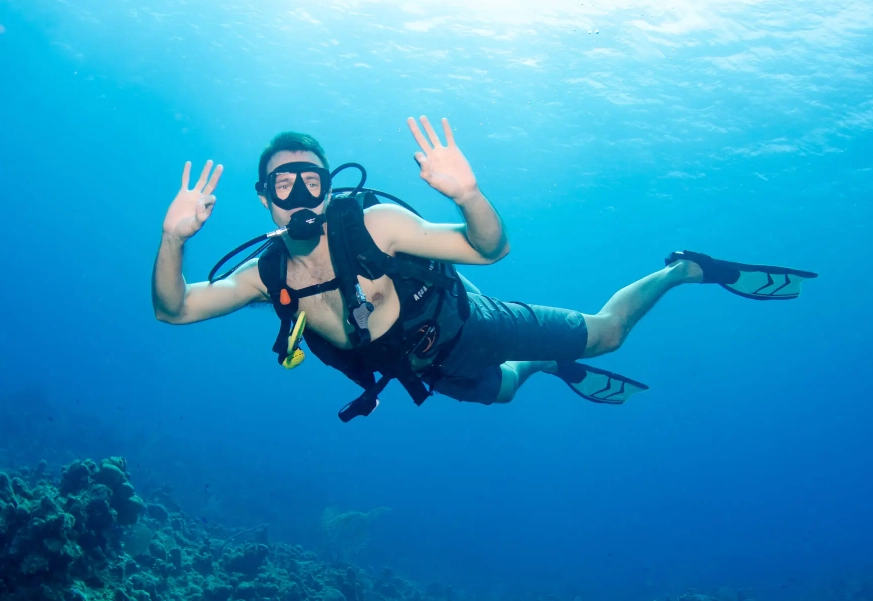
Why it's great: It's incredibly stable. You're in control the whole time. You enter cleanly, and because you're upright, it's easy to get your bearings immediately and give the "okay" signal to the boat. It's perfect for the spacious platforms of dedicated dive boats.
The gotcha: You must look behind you before you step. I mean it. Make it a ritual. Is your inflator hose dangling where it could snag? Is your dive buddy clear? Is there a current pushing the boat? A quick glance saves a lot of hassle. Also, in very rough seas, the platform can be moving too much for a safe stride.
My personal tip? Don't look down at the water as you step. Look at the horizon. It keeps your body straighter and prevents you from crumpling into a belly flop position.
The Backward Roll Entry: For the Rubber Ducks (RIBs)
If you've ever been on a small inflatable boat, you know there's no platform to stand on. You're sitting on the tube. This is where the backward roll comes in. You sit on the edge, facing inward, roll backwards over the side, and let the weight of your tank pull you into the water. It feels a bit weird at first, but it's super efficient.
Why it's great: It's fast. The whole boat can get in the water in seconds. It keeps the boat's center of gravity low, which is crucial for stability. It works brilliantly in choppy conditions where standing up would be dangerous.
The gotcha: You can get momentarily disoriented, especially if you don't keep your mask and regulator firmly in place. There's also a tendency to roll to one side if you're not centered. Practice the motion on dry land first. And for heaven's sake, make sure your air is ON before you roll! It sounds obvious, but in the excitement, people forget.
The Seated Entry: The Cautious and Safe Choice
Sometimes, simple is best. For the seated entry, you just sit on the edge of the platform, swing your legs over, and push yourself gently into the water. You might use this from a low dock, a swimming pool, or even the transom (rear platform) of some boats.
Why it's great: There's almost zero risk of falling. It's the entry of choice for divers who might have mobility concerns or are in a very confined space. It's also great when the water surface is very close to the platform.
The gotcha: It can be slow. With a full tank on your back, twisting to swing your legs can be awkward. You also enter the water in a more horizontal position, which might require a quick adjustment to get upright. It's not very graceful, but who cares? Safety and control trump style every time.
The Forward Roll Entry: The Rare Specialist
Honestly, in 99% of recreational diving, you won't use this. The forward roll is where you enter head-first, tucking into a somersault. It's primarily a training exercise used in pools or very controlled environments to practice immediate skills like mask clearing and regulator recovery from the moment you hit the water.
Why it's used: It simulates a sudden, disorienting entry. It's good for building confidence and skill under mild stress. Some technical divers or public safety divers might use variations in specific scenarios.
The gotcha: It carries a higher risk of hitting your head or face on the bottom in shallow water or striking your tank on the platform. I generally advise recreational divers to stick to feet-first entries. They're safer and more practical. Unless your instructor specifically has you practice it, you can pretty much file this one away as "good to know about, but not necessary."
The Controlled Seated Entry: A Team Effort
This is a hybrid for tricky small-boat situations. Imagine a tiny skiff or a boat with a very narrow, unstable side. Standing for a stride is out. A backward roll might be too risky because of the boat's shape. So, you remain seated on the gunwale (the top edge of the boat's side), facing out. On a count of three, you simply lean back and slide out, often with a gentle push from a buddy sitting across from you to help you clear the boat.
Why it's great: You never stand up, so the boat stays stable. It's a very controlled, low-impact entry for difficult boats.
The gotcha: It requires coordination with your buddy and the boat captain. Clear communication is key. You also need to ensure you slide out far enough so your fins don't hit the side on the way down.
The Shore or Beach Entry: A Whole Different Ballgame
This isn't a single technique but a category of strategies for getting from land into deep enough water to start diving. It can be one of the most challenging parts of a dive. You have to deal with waves, rocks, surf, and walking with fins.
The key strategies:
- Sandy Beach Entry: Walk backwards into the water, fins in hand. Once you're about waist-deep, put your fins on (one at a time, leaning on your buddy for balance). Then either walk or swim backwards through the surf until you're deep enough to descend.
- Rocky Shore Entry: This requires careful planning. Identify a safe, submerged pathway. Often, you'll put your fins on while sitting on a dry rock close to the water, then shuffle or crawl into the water on your behind to avoid slipping. Timing with the waves is critical.
Why it's great: It opens up countless dive sites without needing a boat. It's often cheaper and more flexible.
The gotcha: It can be physically demanding. Surf can knock you over. Rocks are slippery. Currents near shore can be strong. Always scout the exit point before you enter—it looks different from the water! For comprehensive safety guidelines on shore diving, the Divers Alert Network (DAN) has excellent resources on planning and managing risks.
How to Choose: Which of the 6 Types of Dives is Right For You Now?
So you're suited up, ready to go. How do you pick? Run through this quick mental checklist:
- What does the dive guide or captain say? Always listen first. They know the boat and conditions best.
- What's the platform? Big boat = likely Giant Stride. Small RIB = Backward Roll. Shore = Shore Entry techniques.
- How's the water moving? Choppy? A seated or roll entry is better than trying to balance for a stride.
- How do you feel? If you're nervous, choose the most stable, controlled option (often the seated entry). There's no shame in it.
What are the 6 types of dives good for? Ultimately, for giving you options. Being a proficient diver means having the right tool for the job.
Beyond the Basics: Common Questions About Dive Entries
Putting It All Together: From Entry to Awesome Dive
Knowing what the 6 types of dives are is just the first step. The real skill is making the choice automatically, based on your surroundings. It's a sign of an experienced diver.
Think of your entry as the first line of your dive log. A smooth one writes "calm, prepared, in control." A messy one... well, it makes for a funny story later, but it's better to avoid it.
The best way to get comfortable? Practice in a pool or confined water first. If you're unsure about a technique, ask your instructor to go over it again. There are no dumb questions when it comes to safety. And remember, even pros have days where an entry feels off. The goal isn't perfection every time; it's having the knowledge and adaptability to handle whatever platform or shoreline you find yourself on.
So next time someone asks you, "What are the 6 types of dives?" you can tell them it's not just a list—it's your toolkit for starting every underwater adventure on the right fin.
Your comment