So you're thinking about scuba diving in Cancun. Good choice. The warm, turquoise Caribbean water, the insane visibility, and those postcard-perfect reefs make it one of the world's top spots to take your first breaths underwater. But as a beginner, the whole thing can feel overwhelming. Which dive sites won't freak you out? How do you pick a legit dive shop? What should you actually pack?
I've been diving here for over a decade, guiding everyone from terrified first-timers to seasoned pros. Let's cut through the marketing fluff. This guide isn't just a list of dive sites; it's your blueprint for a safe, unforgettable, and genuinely fun first scuba experience in Cancun.
Your Quick Dive Guide
- Why Cancun is a Perfect Playground for Beginner Divers
- Top Beginner-Friendly Dive Sites in Cancun
- Getting Certified: Dive Courses in Cancun
- Planning Your First Cancun Dive Trip: A Sample Itinerary
- Gear Guide: What You Really Need as a Beginner
- Safety First: Non-Negotiable Rules for New Divers
- Your Cancun Diving Questions Answered
Why Cancun is a Perfect Playground for Beginner Divers
It's not just the sunshine. Cancun's geography gives beginners a massive advantage. The main reef system, the Mesoamerican Barrier Reef, sits close to shore in relatively shallow, protected waters. This means short boat rides (less time for nerves to build) and dives typically between 10 to 18 meters (30-60 feet). The water is bath-tub warm year-round (26-29°C / 79-84°F), so you can focus on breathing, not shivering.
The visibility is consistently 20-30 meters (65-100 feet). Seeing your instructor and buddies clearly does wonders for your confidence. Currents on the beginner sites are usually mild to non-existent. You won't be fighting the water; you'll be floating effortlessly, which is the whole point.
Top Beginner-Friendly Dive Sites in Cancun
Forget the deep walls and strong currents for now. These sites are the kindergarten of the diving world—safe, fascinating, and designed for learning.
The Underwater Museum of Art (MUSA)
Why it's great for beginners: It's shallow, has zero current, and is visually mind-blowing. Over 500 life-sized sculptures create an artificial reef teeming with life. It’s a completely unique dive where art and nature collide. You'll practice buoyancy while circling silent crowds of statues, watching corals grow on their faces. It feels more like an exploration than a standard reef dive, which keeps new divers engaged and distracted from any initial anxiety.
El Meco
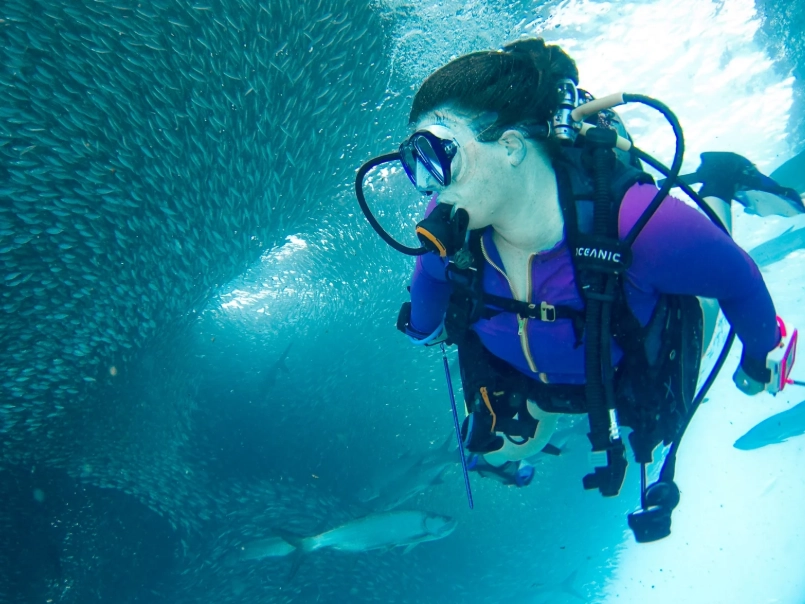
Why it's great for beginners: This is a classic, healthy coral garden. It's a short 10-minute boat ride from the marina. The reef structure is like a rolling underwater hill, perfect for practicing gradual ascents and descents. You're almost guaranteed to see friendly angelfish, parrotfish crunching on coral, and maybe a resting nurse shark tucked under a ledge (they're harmless). The bottom is sandy, so if you need to kneel to adjust gear, you can do so without damaging anything.
Punta Nizuc Reef
Why it's great for beginners: Located at the tip of the Hotel Zone, this site is protected and consistently calm. The coral formations are spectacularly colorful—bright yellow elephant ear sponges, purple sea fans, and massive brain corals. It's an ideal spot for your first open-water certification dives because the conditions are predictable and the marine life is a perfect "textbook" example of a Caribbean reef ecosystem.
Getting Certified: Dive Courses in Cancun
If you're not certified, you'll do a PADI Open Water Diver or SSI Open Water Diver course. It typically takes 3-4 days: one for theory/pool work, and two for four open-water dives. Choosing the right shop is everything.
Look for a dive center that:
- Limits group size. A 4:1 student-to-instructor ratio is ideal. Avoid cattle boats.
- Uses its own, well-maintained boats (not shared charters).
- Has instructors who are native or fluent English speakers if that's your language. Miscommunication underwater is a real safety issue.
- Offers the e-learning option. Do the theory online at home before your trip. It saves vacation time.
A shop I've personally seen maintain high standards over the years is Scuba Cancun. They're not the cheapest, but their boats are good, their gear is new, and their safety record is solid. They're located at Blvd. Kukulcan Km 5.2 in the Hotel Zone. A typical 3-day Open Water course will run you around $450-$550 USD, including all gear and dives. You can find them through major dive aggregator sites.
For a more personalized feel, ask around for smaller, owner-operated shops in downtown Cancun (like Dive Mike). They often have more flexible schedules and passionate instructors.
Planning Your First Cancun Dive Trip: A Sample Itinerary
Here’s how to structure a 5-day trip focused on learning to dive, without burning out.
Day 1: Arrival & Acclimation. Fly into Cancun International (CUN). Stay in the Hotel Zone for convenience. Get settled, have dinner, and do NOT dive tomorrow if you flew in today. Your body needs to off-gas nitrogen from the flight.
Day 2: Theory & Confined Water. Morning: Complete any remaining e-learning or in-person theory session with your dive shop. Afternoon: Your first confined water dives in a pool. This is where you learn essential skills like clearing your mask and recovering your regulator. It’s normal to feel clumsy.
Day 3: Open Water Dives 1 & 2. Morning boat trip. Your first two ocean dives, usually at sites like Punta Nizuc or a shallow MUSA section. You’ll demonstrate skills in the open water and then go for a tour. Exhausting but exhilarating. Rest the entire afternoon—hydration and sleep are crucial.
Day 4: Open Water Dives 3 & 4 & Graduation. Final two dives to complete your certification. You’ll feel noticeably more comfortable. Celebrate! You’re now a certified diver. Maybe a nice dinner at Lorenzillo's (known for lobster).
Day 5: Fun Dive (Optional) & Departure. If you’re feeling confident and your flight is late, book a morning two-tank fun dive with the same shop to El Meco. No skills, just pure enjoyment. Then head to the airport, ensuring at least 18-24 hours after your last dive before you fly.
Gear Guide: What You Really Need as a Beginner
You don't need to buy a full set. Rent from your dive shop. But investing in a few personal items dramatically improves comfort and hygiene.
Must-Buy Personal Gear:
- Mask, Snorkel, Fins: A mask that fits your face perfectly is non-negotiable. Leaky masks ruin dives. Go to a dive shop at home and try on dozens. Get open-heel fins with booties for comfort walking on boats.
- Dive Computer: This is your underwater life-support dashboard. While shops rent them, having your own from day one helps you learn its functions intimately. A basic model like the Cressi Leonardo is a great start.
- Surface Marker Buoy (SMB): A bright inflatable tube you deploy at the surface. Many beginners think this is for "advanced" divers. Wrong. It’s a critical safety tool for marking your location for the boat, especially in surface traffic. Learn to use it early.
What to Rent: Buoyancy Control Device (BCD), regulator, wetsuit (a 3mm shorty is plenty), and tanks. The shop will ensure it's all serviced and working.
Safety First: Non-Negotiable Rules for New Divers
Safety isn't scary; it's empowering. These aren't suggestions.
Equalize Early and Often. The number one cause of aborted dives for beginners is ear pain. Start equalizing (pinch your nose and gently blow) the moment your head goes underwater, and every meter/feet on the way down. If it hurts, stop your descent, ascend a tiny bit, and try again. Never force it.
Never Hold Your Breath. Breathe continuously and slowly. This is the golden rule of scuba.
Stay Close to Your Instructor/Buddy. Within arm's reach. You're a team, not a solo explorer.
Monitor Your Air and Depth. Glance at your gauges every minute or so. Your instructor will too, but you need to build the habit.
Listen to the Briefing. The site map, hand signals, and emergency procedures discussed on the boat are there for a reason.
Respect the Marine Life. Look, don't touch. Not just for their safety, but for yours. Coral cuts are nasty, and some creatures defend themselves.
Your Cancun Diving Questions Answered
Is Cancun good for beginner scuba divers?
It's one of the best places on the planet to start. The combination of warm, clear, calm water, shallow reefs close to shore, and a huge number of professional, English-speaking dive operations specifically catering to tourists makes the learning curve much gentler than in many other destinations.
What is the best time of year for beginner diving in Cancun?
The water is warm year-round, but for beginners, aim for the dry season, roughly December through April. The seas are at their calmest, with minimal chance of rain or wind canceling your boat trip. Summer and fall can be fantastic too, but you have a higher probability of encountering some surface chop or brief afternoon storms.
I’m nervous about equalizing my ears. Any tips?
This is the most common hurdle. Before you even get on the boat, practice on land. Pinch your nose and gently try to blow air out of it until you feel the "pop" in your ears. On the dive, start the second your mask is underwater. Descend feet-first, slowly, using the anchor or mooring line as a guide. Equalize with every exhale. If one ear is stubborn, tilt your head to stretch the Eustachian tube. Communicate with your instructor immediately if you have trouble—they have tricks.
Can I dive in Cancun if I wear glasses or contact lenses?
Absolutely. Soft contact lenses are fine underwater. A better, more permanent solution is to get a prescription dive mask. You can order them online or at some larger dive shops. It makes identifying fish and reading your gauges infinitely easier and is worth the investment if you plan to keep diving.
What’s one mistake you see new divers make in Cancun all the time?
Overweighting. Instructors often put a little extra weight on beginners to keep them from floating up. But once you're underwater and comfortable, that extra weight makes you sink like a rock, forcing you to put too much air in your BCD to compensate. This leads to poor, unstable buoyancy. On your second or third dive, politely ask your guide, "Can we check my weight? I think I might be a little heavy." A proper weight check at the end of a dive (floating at eye level with an empty BCD and holding a normal breath) is a game-changer.
Your first scuba dive in Cancun should be about wonder, not worry. By choosing the right sites, a reputable shop, and focusing on these core safety principles, you’ll set yourself up for a lifetime of incredible underwater exploration. The reefs are waiting. Take a deep breath, and go see them.
Comments