You typed "how many types of diving in air" into Google. I get it. The world of skydiving seems massive, confusing, and frankly, a bit intimidating from the outside. Is it all just jumping out of a plane? Far from it. As someone who's been in and around drop zones for over a decade, I can tell you that "air diving"—or more accurately, skydiving—branches into distinct disciplines, each with its own culture, skillset, and adrenaline profile. The simple answer is there are five primary categories that cover 99% of what happens up there. But the real answer, the one that helps you choose your path, is more nuanced.
Your Quick Guide to Air Diving
Most people's journey starts with a single image: freefall. But that's just one phase. The type of skydiving is defined by how you exit, how you fall, and how you land. Let's move past the generic brochures and talk about what each type actually feels like and who it's for.
Tandem Skydiving: Your First Taste of the Sky
This is the gateway. Over 90% of first-timers experience skydiving this way. You're harnessed to a certified tandem instructor who handles all the technical stuff—altitude awareness, parachute deployment, landing pattern. Your job is to breathe, scream, grin, and enjoy the ride.
It sounds straightforward, but here's the detail most drop zones won't emphasize: the quality of your tandem jump is 90% dependent on your instructor's attitude, not the plane or the view. A great instructor reads your body language, gives clear, calm commands, and makes you feel like a participant, not cargo. A bored instructor can make the experience feel transactional.
What it's really like: The door opens at 13,000-15,000 feet. The noise is overwhelming. You'll shuffle to the edge. The instructor counts down—3, 2, 1—and you're out. The first 2-3 seconds are a bizarre sensory overload of wind and acceleration. Then, at terminal velocity (about 120 mph), it smooths out into a surreal, peaceful float. The instructor might let you steer a bit. After 45-60 seconds of freefall, the parachute opens with a firm jerk, and you get 5-7 minutes of a serene canopy ride down.
Who it's for: Absolutely anyone looking for a one-time bucket-list adventure or a low-commitment way to see if they love the sensation of freefall. No prior experience needed.
Static Line & Accelerated Freefall: Learning to Fly Solo
If tandem is the appetizer, this is the main course of learning. These are the two main training methods to get your solo skydiving license (the USPA A-license in the US).
Static Line Jumping
The old-school method. A cord (the static line) is attached from the plane to your parachute. You jump out at a lower altitude (around 3,500 feet), the line automatically deploys your canopy almost immediately, and you have no freefall on your first jumps. You learn canopy control first. It's cheaper per jump but takes more jumps to reach freefall. It's methodical, some say slower, but builds rock-solid fundamentals under canopy. It's less common in the US now but still popular in Europe and for military training.
Accelerated Freefall (AFF)
The modern standard. You jump from full altitude (13,000+ feet) on your very first solo jump—but with two instructors holding on to you. They're there to stabilize you and give hand signals. You have a full freefall on jump #1. It's intensive, more expensive per jump, but faster progression. The mental hurdle is bigger, but the reward is immediate.
Here's the non-consensus point everyone argues about: AFF isn't inherently "safer" than Static Line. It's different. AFF puts you in the complex freefall environment immediately, with close supervision. Static Line isolates the variable (canopy flight) first. The safety comes from the quality of the instruction and your mindset, not the acronym of the program. I've seen students thrive and struggle in both.
Solo Disciplines: Where Skydiving Becomes an Art
Once you're licensed, the sky literally becomes your playground. This is where the "how many types" question explodes. These aren't separate sports, but specialized skills within solo skydiving.
| Discipline | Core Focus | Skill Level Required | The Vibe |
|---|---|---|---|
| Formation Skydiving (FS) | Building geometric formations (stars, diamonds) with a team in belly-to-earth orientation. | Intermediate (50+ jumps) | Team sport in the sky. Precise, communicative, like aerial chess. |
| Freeflying | Flying in any orientation: head-down, sit-fly, back-fly. Dynamic and acrobatic. | Advanced (200+ jumps recommended) | Creative, athletic, and visually stunning. High injury risk if poorly trained. |
| Canopy Piloting (Swooping) | High-performance maneuvers under an open parachute, often involving high-speed turns near the ground. | Expert (Highly specialized, requires specific gear) | The "formula one" of skydiving. Incredibly technical, with the highest statistical risk factor. |
| Accuracy Landing | Landing a parachute on a precise target, often a small electronic disc. | Beginner to Expert | Technical, focused, and meditative. Less about thrill, more about precision. |
| Vertical Formation Skydiving (VFS) | Building formations in head-down or other vertical orientations. | Advanced/Expert | The high-speed, high-skill version of FS. Intense and fast-paced. |
Most skydivers dabble in a few. I gravitated toward freeflying and accuracy. The swooping community is almost a separate tribe at the drop zone—they live for that brief, intense moment under canopy. It's not for me; the margin for error is too slim for my taste, but I respect the skill.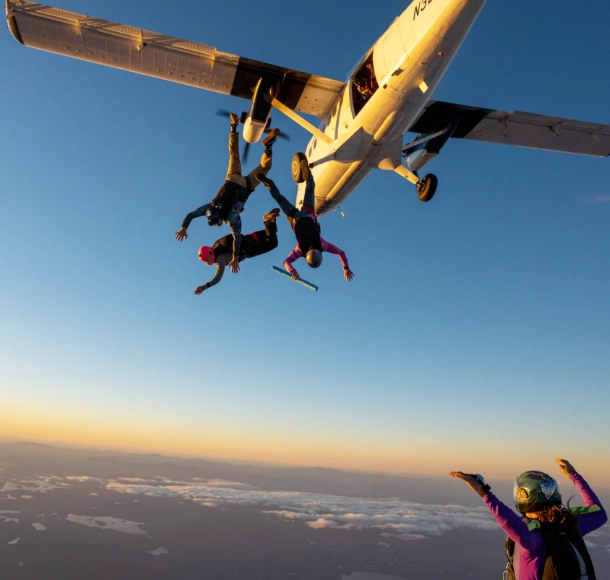
Wingsuit Flying: Becoming the Human Bird
This is the iconic, squirrel-suit flying you see in videos. A wingsuit adds surface area between your legs and under your arms, transforming your body into a wing. You achieve forward glide, sometimes at a ratio of 2.5:1 or more (for every foot you fall, you glide 2.5 feet forward).
Prerequisites are non-negotiable: Most countries and safety organizations require a minimum of 200 skydives before your first wingsuit flight. This isn't bureaucracy; it's survival. You need ingrained altitude awareness, stable freefall skills, and the ability to handle malfunctions without panic. Jumping a wingsuit with less is like learning to drive in a Formula 1 car.
The sensation is unlike anything else. The roar of the wind is louder, but the feeling of gliding rather than just falling is profound. You fly along mountain ridges, through clouds (not recommended without serious training), over landscapes. It's the closest humans get to bird-like flight.
Indoor Wind Tunnels: Practice Without a Plane
Is this "diving in air"? Absolutely. Vertical wind tunnels generate a column of air strong enough to support a human body. It's used for three things:
1. First-Time Fun: A 2-minute tunnel session gives you the freefall sensation without the plane ride. Great for kids or those unsure about the full jump.
2. Training Gold: For students and pros, tunnel time is invaluable. An hour in the tunnel can equal dozens of skydives for skill development. You get immediate, repeated feedback from a coach standing right next to you.
3. Competitive Sport: Indoor skydiving is now an official sport with world championships in dynamic formation flying and artistic routines.
Facilities like iFLY have locations worldwide. It's expensive per minute, but as a learning tool, it's unbeatable. It demystifies body flight.
How to Choose Your Type of Skydiving
Don't get lost in the options. Follow this decision tree:
Step 1: The Bucket-List Check.
Just want to say you did it? Tandem Skydiving. Full stop. Book with a reputable drop zone (look for USPA or equivalent national association affiliation).
Step 2: The "I Think I'm Hooked" Moment.
If you finish your tandem and immediately want to do it again, you're a candidate for learning. Visit the drop zone, talk to students and instructors. Ask about their AFF vs. Static Line philosophy. Choose the program that fits your learning style and budget, not the one someone says is "the best."
Step 3: The Licensed Explorer (After 25-50 jumps).
Now you can sample. Try a 4-way FS jump. Take a canopy control course. Maybe try a beginner tunnel session to work on belly flying. Don't specialize yet. Be a tourist in your own sport.
Step 4: Finding Your Tribe (100+ jumps).
You'll naturally gravitate toward the people doing what looks fun to you. Want to be creative and acrobatic? Look into freefly coaching. Love the technical details of gear and flight paths? Canopy piloting might call. Crave epic landscapes and longer flight times? Start working toward wingsuit requirements.
Your Burning Skydiving Questions Answered
So, how many types of diving in the air are there? You've got the five main pathways: Tandem, Student (AFF/Static Line), Solo Disciplines (FS, Freefly, Canopy Piloting), Wingsuit Flying, and Indoor Tunnel. Each one opens a different door to the sky.
The number isn't what's important. What matters is finding the type that matches your version of flight. Maybe it's a single, unforgettable minute of freefall. Maybe it's the quiet focus of landing on a dime. Or maybe it's the dream of soaring. They all start with looking up and wondering, "What if?"
Your next step is simple. If you're curious, find your nearest USPA-affiliated drop zone (or your country's equivalent association) and just go watch for an afternoon. Talk to people. Feel the vibe. The sky isn't going anywhere.

Comments