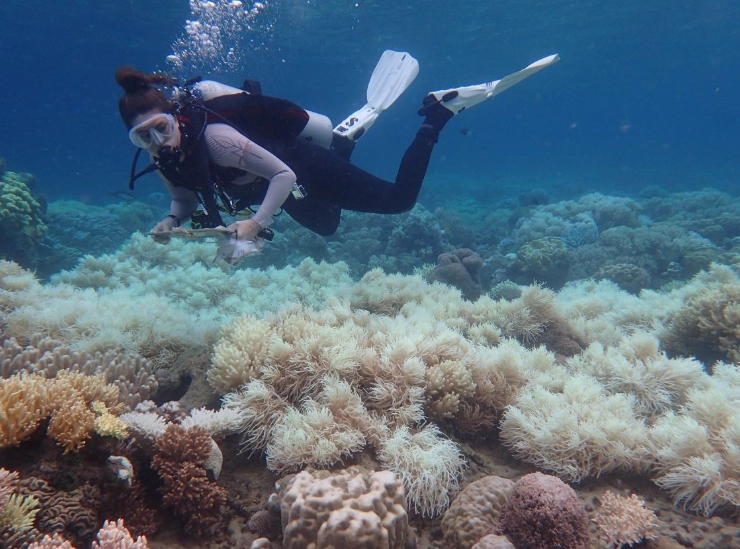
If you've spent any time around experienced scuba divers, you might have heard the term "flying dive" tossed around. It sounds cool, maybe a bit mysterious. Is it a specific type of entry? A fancy trick? Let's cut straight to it: a flying dive isn't about how you get into the water. It's about what you do once you're under the surface. It's the pinnacle of controlled, horizontal movement through the water column, achieved by mastering perfect neutral buoyancy and a streamlined, prone body position. Think of it as underwater flight, where you glide effortlessly without touching the bottom, disturbing silt, or damaging fragile coral. It's the skill that separates good divers from great ones.
What You'll Learn in This Guide
What Exactly Is a Flying Dive?
Let's be honest, most divers think they have good buoyancy until they try a flying dive. A traditional dive often involves a bit of vertical bobbing, occasional fin contact with the bottom, and constant adjustments. A flying dive eliminates all that. It's defined by sustained, level travel at a constant depth, using minimal fin movement. Your body is parallel to the bottom (or the surface), arms streamlined at your sides or out in front, and you're literally flying over the reef or wreck.
The key difference? Intent and precision. On a regular dive, you might achieve this position for a few seconds. A flying dive means holding it for minutes at a time, throughout the entire dive if possible. It requires an intimate understanding of your buoyancy compensator (BCD), your breathing, and your trim (your body's orientation in the water). Organizations like PADI address these skills in their Peak Performance Buoyancy specialty, but the concept of the "flying dive" itself is more of a community-driven benchmark of excellence.
Think of it this way: If normal diving is like walking through a museum, a flying dive is like floating on a hoverboard through it. You get a better view, you don't kick up dust, and you don't risk bumping into the exhibits.
The Core Benefits: Why Master the Flying Dive?
This isn't just a party trick. Mastering the flying dive technique transforms your entire diving experience and makes you a better steward of the underwater world.
Unmatched Environmental Protection
This is the biggest one. By staying off the bottom, you prevent damaging delicate marine life like coral polyps, sea grasses, and anemones. You also avoid stirring up silt, which can smother organisms and ruin visibility for everyone (including you). It's the most responsible way to dive.
Dramatically Reduced Air Consumption
When you're perfectly balanced, you expend far less energy. You're not fighting to go up or down. Your fin kicks become small, efficient flicks rather than powerful, air-gulping strokes. I've personally seen my air consumption improve by nearly 20% on dives where I focus on maintaining a flying position. That means longer bottom times.
Superior Observation and Photography
Stable, silent flight is a game-changer for underwater photography and videography. You can hover motionless to frame a shot, approach skittish creatures without spooking them, and get angles that clumsy, buoyant divers simply can't. Your dive becomes more about observation than locomotion.
How to Perform a Flying Dive: A Step-by-Step Guide
Ready to try it? Don't just jump in and hope for the best. Break it down. I recommend practicing in a pool or a shallow, sandy site with good visibility first.
Step 1: Master Neutral Buoyancy at a Halt
This is non-negotiable. Before you can fly, you must hover. Descend to your desired depth. Empty your BCD completely. Now, using only your lungs, control your ascent and descent. Breathe in to rise a few inches, breathe out slowly to sink. Find the breath volume that keeps you perfectly still. This is your "neutral breath." Get comfortable here for a few minutes.
Step 2: Achieve Perfect Horizontal Trim
Trim is your body's angle. Most new divers are head-up, fin-down. You need to be flat. Shift weight on your belt or tank band. Move your tank up or down. Often, the secret is moving weights from your waist to your tank's trim pockets. Arch your back slightly, look ahead, and extend your legs. Your body should feel like a seesaw balanced in the middle.
Step 3: Initiate Movement with Minimal Force
Now, add the gentlest flutter kick from your hips, not your knees. Your ankles need to be loose. The goal is to move forward without changing depth. Pay intense attention to your chest. If you start to rise, exhale a bit more. If you sink, add a tiny, tiny puff of air to your BCD—we're talking half-second presses. The adjustments are minute.
Step 4: Integrate Breathing for Micro-Adjustments
This is the expert level. Instead of reaching for your inflator for every minor depth change, use your lungs first. A slightly fuller breath can lift you over a small coral head. A longer exhale can dip you under an overhang. Your breathing becomes your primary altitude control, with the BCD as the coarse adjustment.
Common Mistakes and How to Fix Them
Everyone makes these errors. Spotting them is half the battle.
| Mistake | What It Looks Like | The Fix |
|---|---|---|
| Bicycle Kicking | Bent knees, big, sweeping kicks that push water up and down. You go nowhere fast and silt out the bottom. | Practice kicks with straight legs, using your core and glutes. Imagine kicking in a tight tube. |
| Over-Trimmed Head Down | Your head is lower than your fins, forcing you to kick upward to stay level. Exhausting. | Move weight back. Check if your tank is too high. Look forward, not straight down. |
| Death Grip on the Inflator | Constantly adding and dumping air in large bursts, causing a yo-yo effect. | Let go. Use your lungs for 30 seconds. Only then, make a micro-adjustment with the inflator if needed. |
| Rigid Ankles | Stiff fins that don't flex, creating drag and poor propulsion. | Consciously relax your feet. Fins should be an extension of a flexible foot, not a plank. |
A mistake I rarely see discussed is ignoring your wing's exhaust valve. On a descent during a flying dive, you must be able to dump air quickly from any position. If your dump valve is behind your head and you're in a flat trim, you can't reach it. Practice using your shoulder dump or oral inflator to vent air before you need to.
Gear Considerations for Optimal Flight
The right gear won't teach you the skill, but wrong gear will fight you every step of the way.
BCD vs. Wing: A back-inflation wing or BP/W (backplate and wing) system is inherently better for trim. It keeps air behind you, promoting a horizontal position. A jacket-style BCD puts air around your torso, which can make you more upright. You can fly in a jacket, but it's harder.
Fin Choice: Heavy, stiff fins require more effort. Lighter, more flexible fins (often preferred by tech divers) allow for smaller, more efficient kicks. Try different styles.
Weight Integration: This is huge. A weight system that lets you move small increments to your tank (like trim pockets) is invaluable for dialing in your trim. Ditching ankle weights is usually the first step to better trim.
Essential Safety Rules for Flying Dives
With great skill comes great responsibility. Never let the pursuit of a perfect flying dive compromise safety.
Maintain Buddy Contact and Awareness: You're focused on your body. It's easy to become hyper-focused and lose track of your buddy, depth, time, and air. Set a rule to check your gauges and your buddy every 30 seconds, without fail.
Plan Your Ascent Before You're Low on Air: Flying dives are so efficient you might be surprised how quickly you use up your no-deco time while still having plenty of air. Plan your safety stop depth and location early.
Always Have a Dump Valve Within Reach: As mentioned, know how to dump air from your BCD in your flying position. An uncontrolled ascent from 20 meters is dangerous, no matter how good your trim was.
Respect Your Limits: Don't attempt complex flying dives in strong current, around entanglement hazards, or in overhead environments until the skill is second nature in open water. The Divers Alert Network (DAN) consistently reports incidents where divers focused on a task became distracted from primary hazards.
Your Flying Dive Questions Answered
I always seem to drift upwards during my flying dive. What am I doing wrong?
You're likely overweighted. It's a classic error. Divers add weight to make the initial descent easier, but then they need constant air in their BCD to be neutral. That air expands as you fly over the reef (which is often shallower), causing you to rise. Do a proper buoyancy check at the end of a dive with a near-empty tank. You should be neutral at safety stop depth with 500 PSI and an empty BCD. Remove weight until you achieve that.
Is a flying dive only for advanced or tech divers?
Not at all. The fundamentals are taught in basic open water courses—they're just not labeled "flying dive." Any recreational diver can and should work on these skills. It makes you safer, more efficient, and more environmentally friendly. It's the logical next step after getting your basic certification.
Can I practice flying dive skills without going on a full ocean dive?
Absolutely. The pool is your best friend. Practice hovering motionless at different depths. Practice swimming lengths while trying to not let your fins break the surface or touch the bottom. Many local dive shops offer "pool tune-up" sessions which are perfect for this. It's cheaper than a boat dive and you get focused, repetitive practice.
My buddy isn't interested in perfect buoyancy. How can I work on my flying dive without leaving them behind?
This is a common social challenge. First, communicate your goal at the surface. Suggest you both do a buoyancy-focused dive where you move slowly and deliberately. Often, they'll enjoy the longer bottom time. If they're truly uninterested, you can still work on your trim and kicks while staying with them—just be the model diver who glides effortlessly beside them. Your good example might just inspire them.
Comments