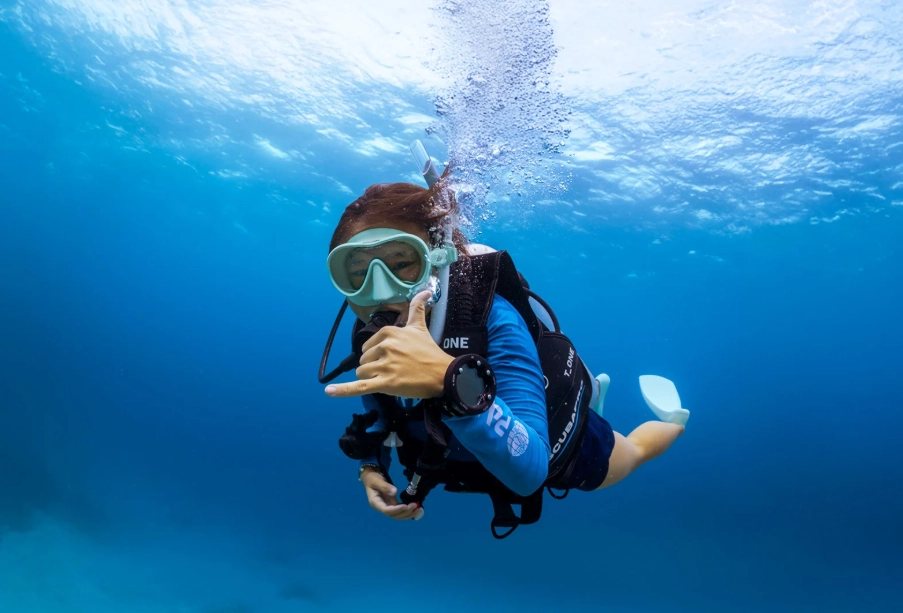
You're 15 meters deep, everything's perfect, and you give your buddy a thumbs up. You mean "I'm good." They see it and immediately start swimming to the surface, ending the dive. Confusion sets in. This happens more than you'd think. In scuba diving, the thumbs-up gesture has one specific, critical meaning: "End the dive. Ascend to the surface now." It is not a casual "okay" or "all good." Misunderstanding this signal isn't just awkward—it can be dangerous, leading to uncontrolled ascents and omitted safety stops. Let's cut through the confusion and get this right.
What You'll Learn in This Guide
What Does Thumbs Up Really Mean in Scuba Diving?
Forget everything you know about thumbs up on land. Underwater, it's a procedural command. When you make a fist with your thumb pointed upward and show it to your buddy or dive leader, you are communicating one thing: "I am ending my dive. I am going to make a controlled, safe ascent to the surface starting now."
This is non-negotiable in formal dive training from agencies like PADI and SSI. The signal initiates the end-of-dive protocol. Once given and acknowledged, both divers should:
- Check their remaining air and depth.
- Agree on the ascent path (e.g., along the anchor line or a reef wall).
- Begin a slow ascent, typically not faster than 9 meters per minute.
- Perform a safety stop at 5 meters for 3 minutes (if within no-decompression limits).
The Critical Misconception: Thumbs Up vs. Thumbs Down
Here's the big trap. New divers, and even some experienced ones who learned in casual environments, often think:
- Thumbs Up = "I'm okay" or "Everything's good."
- Thumbs Down = "Something's wrong" or "Let's go down."
This is backwards and dangerously incorrect. A thumbs down signal in recreational diving typically means "go deeper" or "descend." It's used at the start of a dive when you agree to go down, or during a dive to indicate you want to explore a lower depth. Using it to indicate a problem is a major source of confusion.
I saw this firsthand on a dive boat in the Maldives. A newly certified diver kept giving his guide a thumbs up every few minutes, thinking he was saying "I'm fine." The guide, thinking the diver wanted to end the dive early each time, was getting increasingly frustrated. The debrief was a crucial learning moment for everyone on board.
So How Do You Say "I'm Okay" Underwater?
You use the "OK" signal. Form a circle with your thumb and index finger, extending the other three fingers. This is the universal underwater sign for "Are you okay?" and "I am okay." It's used for status checks, not for dive procedures.
The sequence is simple: Point to your buddy, make the OK signal (asking "You okay?"). They respond with the same signal back ("I am okay"). This is your casual check-in, not the thumbs up.
Other Essential Scuba Diving Hand Signals You Must Know
Hand signals are your underwater language. Relying only on thumbs up and OK is like knowing only "hello" and "goodbye" in a foreign country. Here are the non-negotiables.
| Signal | Gesture | Meaning & When to Use It |
|---|---|---|
| Low on Air | Make a fist and tap your chest (over your tank valve) repeatedly. | Indicates your air supply is running low (usually at reserve pressure, around 50 bar/700 psi). This signals the need to end the dive soon. |
| Out of Air | Draw a flat hand across your throat in a slicing motion. | EMERGENCY. You have no air to breathe. Requires immediate buddy breathing or controlled emergency ascent. |
| Something's Wrong / Problem | Extend your hand flat and rock it side-to-side (like a wobbly pancake). | A general "I have a problem" signal. Follow it by pointing to the issue (ear, mask, fin, etc.). |
| Stop / Hold Position | Hold a flat hand up, palm facing your buddy. | "Stop moving." Used to get attention, regroup, or before discussing something. |
| Look / Watch That | Point with two fingers at your own eyes, then point towards the object. | Directs your buddy's attention to something interesting or important. |
| Go Up / Ascend a Little | Flat hand, palm down, making an upward lifting motion. | "Let's rise a few meters." Different from Thumbs Up, as it doesn't mean end the dive, just adjust depth. |
Most dive professionals agree that the "low on air" and "problem" signals are just as critical as the thumbs up. A clear low-on-air signal prevents the out-of-air emergency. The key is to review these with your buddy on the surface, every single dive. Don't assume they use the same signals you do.
How to Avoid Confusion and Dive Safer
Mistakes happen. Here's how to build an iron-clad communication system with any buddy.
1. The Pre-Dive Buddy Check (BWRAF) is Your Communication Foundation. During the "Final Okay" part of the check, quickly run through hand signals. Say: "Remember, thumbs up means end the dive and ascend. Thumbs down means go deeper. This is the OK signal. This is low on air." Takes 20 seconds, prevents 99% of issues.
2. Use a Slate or Wet Notes. For complex messages like "follow this reef wall," "wait here for the turtle," or "my computer says 3 min safety stop left," write it down. It's foolproof.
3. Establish Eye Contact and Confirm. Don't just flash a signal. Get your buddy's attention, make the signal clearly, and wait for them to acknowledge it with the same signal or an OK. If you give a thumbs up, they must return a thumbs up to confirm they understand the dive is ending.
4. The Golden Rule for New Buddies. If you're diving with someone new and they give you a confusing signal (like a casual thumbs up), immediately respond with the "Stop" signal. Then, make the "OK?" signal. If they return OK, use your slate or gestures to clarify on the spot. Never ignore a signal you don't fully understand.
A common error I see even with experienced divers is looking at their computer during the ascent instead of their buddy. Your primary focus after a thumbs-up agreement should be your buddy and your ascent rate, not your nitrox percentage. The computer is secondary.
Your Thumbs-Up Questions Answered
What if I need to surface urgently due to an equipment failure? Do I still use the thumbs up?
First, get your buddy's attention with the "Stop" or frantic waving. Then, signal the specific problem (e.g., point to a leaking regulator). Finally, give a very clear, emphatic thumbs up. The sequence communicates: "Attention! Problem! We must surface NOW." This is different from a calm, planned end-of-dive thumbs up. The urgency in your movement provides critical context.
I see dive guides on TV giving a thumbs up and then continuing the dive. What's that about?
This is often edited for TV. Alternatively, they may have a pre-arranged, non-standard signal within their closed team. Never mimic this. Recreational divers must adhere to the universal standard for safety. What works for a film crew with surface-supplied air and safety divers is irrelevant to your recreational dive.
How do I signal to end the dive but stay at our safety stop depth?
You still use the initial thumbs up to agree the dive is over. During the ascent, when you reach 5 meters, you stop. To communicate "let's stay here for our safety stop," you can point to your computer showing 5m, make the "Stop" signal, and then show three fingers (for 3 minutes). The thumbs up initiated the ascent; other signals manage the stop.
My buddy gave me a thumbs up but I have 100 bar left and don't want to surface. What should I do?
This is a critical decision point. Do NOT just ignore it. Use your slate to ask "Why?" or make the "Problem?" signal. They may have a cramp, be cold, or feel unwell. If they confirm they're okay but just "done," you have a choice, but the safe and buddy-centric principle is to ascend together. A dive plan should include a minimum air pressure for the thumb-up decision. Sticking to that plan prevents this dilemma.
Are there any differences in the thumbs-up meaning in technical diving?
Yes, the meaning is even more specific. In tech diving, a thumbs up often means "ascend to the next decompression stop or the surface," depending on the agreed plan. Communication is even more critical due to complex gas switches and deco obligations. Tech divers rely heavily on detailed pre-dive briefings and often use finger numbers to specify exact depths for ascent.
The thumbs up is the most important procedural signal in diving. It's not a suggestion; it's a plan to change your environment in a potentially dangerous way. Respect it, use it correctly, and always confirm. Your safety, and your buddy's, depends on this simple gesture being understood perfectly. Next time you're about to give that thumbs up, pause for a second. Make sure you really mean "let's go up," and make sure your buddy is looking right at you.

Comments